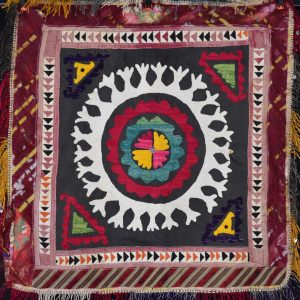
Description
A Turkman torba is a small, flatwoven or pile storage bag made by Turkmen tribes, traditionally used to hold personal or ceremonial items inside a yurt.It is one of the most collectible forms of Turkmen weaving because it condenses tribal identity, gul symbolism, and superb craftsmanship into a compact format.
A torba is a rectangular bag or trapping woven by Turkmen tribes (Tekke, Yomut, Ersari, Saryk, Salor). Historically, torbas were used to store small valuables, cosmetics, sewing tools, amulets, or dowry items inside nomadic tents. They were often hung on tent walls, camel litters, or dowry trappings. Turkmen weaving is deeply tied to nomadic life, and torbas were part of a larger set of household textiles including chuvals, asmalyks, and ok bash trappings.
Key Characteristics
- Format: Long, narrow rectangle; usually 30–60 cm high and 70–120 cm wide.
- Structure: Can be pile-woven (knotted) or flatwoven (kilim back).
- Colours: Dominated by deep madder reds, with dark browns, ivory, and indigo accents.
- Motifs: Always tribal—especially guls, which act like clan emblems.
- Use: Storage, dowry display, and ceremonial decoration.
Torba Types by Tribe
Tekke Torba
- Fine weave, high knot count, silky wool.
- Tekke gul repeated in rows; elegant, balanced geometry.
- Often the most refined and collectible.
Yomut Torba
- More open designs, often with diamond motifs and strong border systems.
- Colours slightly softer; more variation in browns and ivory.
Ersari Torba
- Larger-scale motifs, sometimes elephant-foot guls or spacious layouts.
- Earthier palette; often more rustic.
Saryk & Salor Torba
-
How to Identify an Authentic Torba
- Hand-knotted back shows clear pattern (not blurred).
- Wool quality is lustrous and springy.
- Natural dyes (pre‑1910) show warm, organic tones; later pieces may use synthetics.
- Tribal gul structure matches known Tekke, Yomut, Ersari, etc. patterns.
-