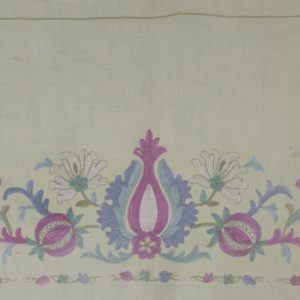
Description
Phulkari is the vibrant, memory‑laden embroidery tradition of Punjab — a textile language of geometry, color, and women’s stories. At its heart, it’s darning‑stitch embroidery on handwoven cotton (khaddar) using untwisted silk floss (patt), worked from the back to create shimmering patterns on the front.
Meaning: From phul (flower) + kari (work) — “flower work.”
• Technique: Long, rhythmic darning stitches, always done without tracing; the embroiderer visualizes the pattern and works by memory.
• Materials:
• Base: coarse cotton khaddar in off‑white, red, or indigo
• Thread: glossy silk patt
• Aesthetic: Bold geometry, stylized florals, diamonds, chevrons, and shimmering surfaces created by directional stitch play.
🌾 Cultural significance
Phulkari was never just decoration — it was a woman’s personal archive.
• Grandmothers began stitching a girl’s phulkari at her birth.
• Girls learned the craft as a rite of passage.
• Dozens of phulkaris and baghs formed part of a bride’s trousseau.
Folk songs celebrate the emotional bond between mother, daughter, and cloth.
Partition in 1947 nearly erased the tradition, but revival efforts in both India and Pakistan have brought it back into cultural visibility.
🧵 Types of Phulkari
• Phulkari (narrow embroidery): Motifs scattered so the base cloth remains visible.
• Bagh (“garden”): Dense, all‑over embroidery that completely covers the surface.
• Chope: Red cloth with yellow embroidery, traditionally gifted before marriage.
• Tilpatr, Neelak: Regional variations with distinctive motifs and color palettes.
✨ Why it matters
Phulkari is one of the most symbolically rich textile traditions of South Asia — a fusion of geometry, memory, and women’s artistry. For a collector like you, Peter, it sits beautifully alongside your interests in symbolism, ritual motifs, and authentic handwork. Its play of light, stitch direction, and colour makes it a powerful textile for both