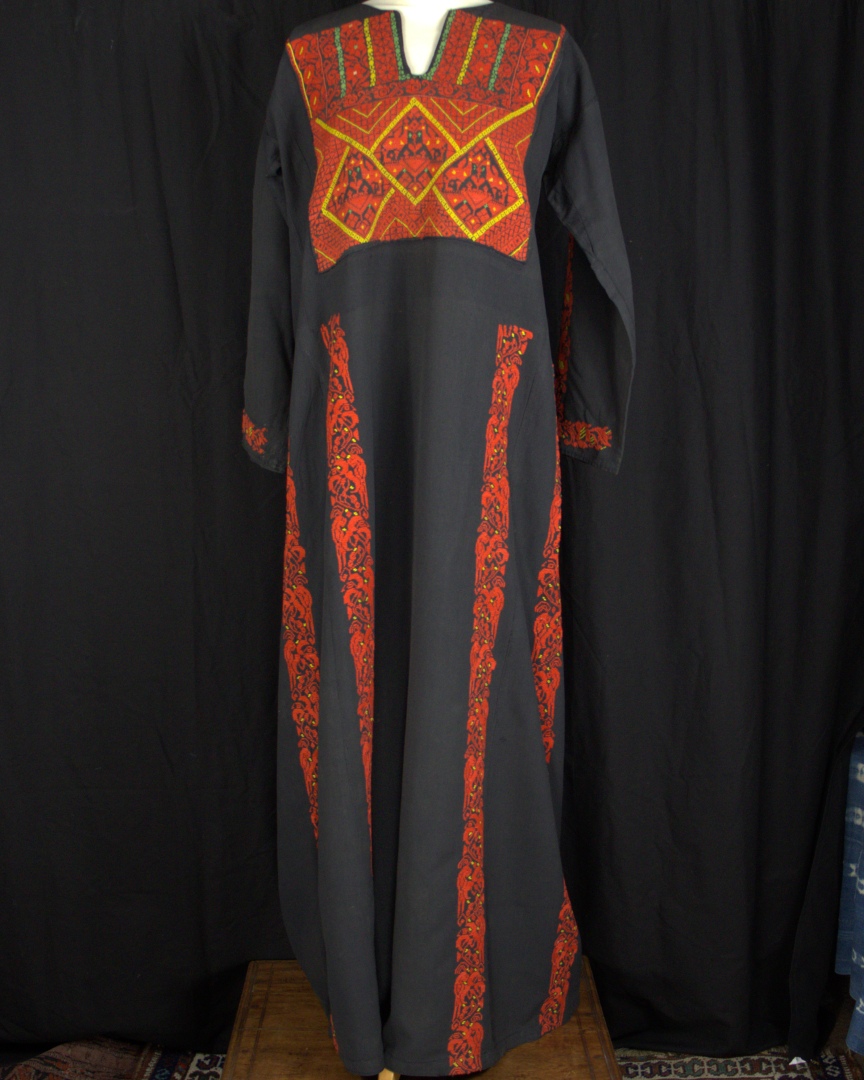


Description
A Palestinian thobe is a textile system of identity — a long, embroidered dress whose cut, motifs, and colours encode a woman’s village, status, and story.
A loose‑fitting, ankle‑length dress with long sleeves and a rectangular chest panel (qabbeh). Its defining feature is tatreez — cross‑stitch embroidery in silk or cotton threads, often red, worked onto linen, cotton, wool, or indigo‑dyed cloth.
- It functions as geographic identity, social biography, and cultural memory.
- Historically, girls learned tatreez from childhood, preparing embroidered trousseaus that reflected their village and family.
- The form of the thobe solidified in the 19th century, though embroidery traditions trace back to the Mamluk era (13th–16thC)Palestinian thobes are not one garment but a constellation of regional styles. Four major groups dominate:
1. Ramallah & Central Highlands
- Light cotton/linen bases
- Heavy red cross‑stitch on chest, sleeves, hem
- Straight silhouette, wide sleeves
- Motifs: cypress, rosettes, diamonds
2. Hebron (Al‑Khalil)
- Dark wool or indigo bases
- Dense, angular geometric embroidery
- Tricolour appliqués, branch patterns
- Among the most complex geometric traditions
3. Bethlehem (Malak thobe)
- Silk couching (tahriri) in gold/silver
- Raised texture, velvet panels
- Ceremonial prestige; wealthier families
4. Gaza & Southern Coast
- Indigo‑dyed bases
- Flowing, less rigid motifs
- Purple/blue palettes


