

Description
-
Central Asian embroidery is defined by bold colour, protective symbolism, and region-specific stitch traditions that reflect nomadic heritage and Silk Road exchange.
Across Uzbekistan, Kazakhstan, Kyrgyzstan, Turkmenistan, and Tajikistan, embroidery functions as cultural identity, protection, and social status. Patterns often reflect nomadic life, mythology, and ancestral lineage, stitched in techniques such as chain stitch, couching, and cross‑stitch.
Embroidery historically decorated clothing, household textiles, animal trappings, and ceremonial objects, shaped by Islam, shared ancestry, and Silk Road trade networks.
. Suzani (Uzbekistan, Tajikistan)
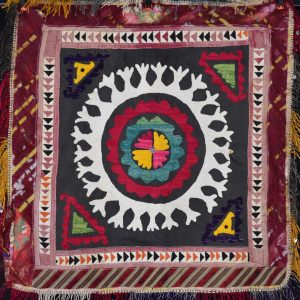
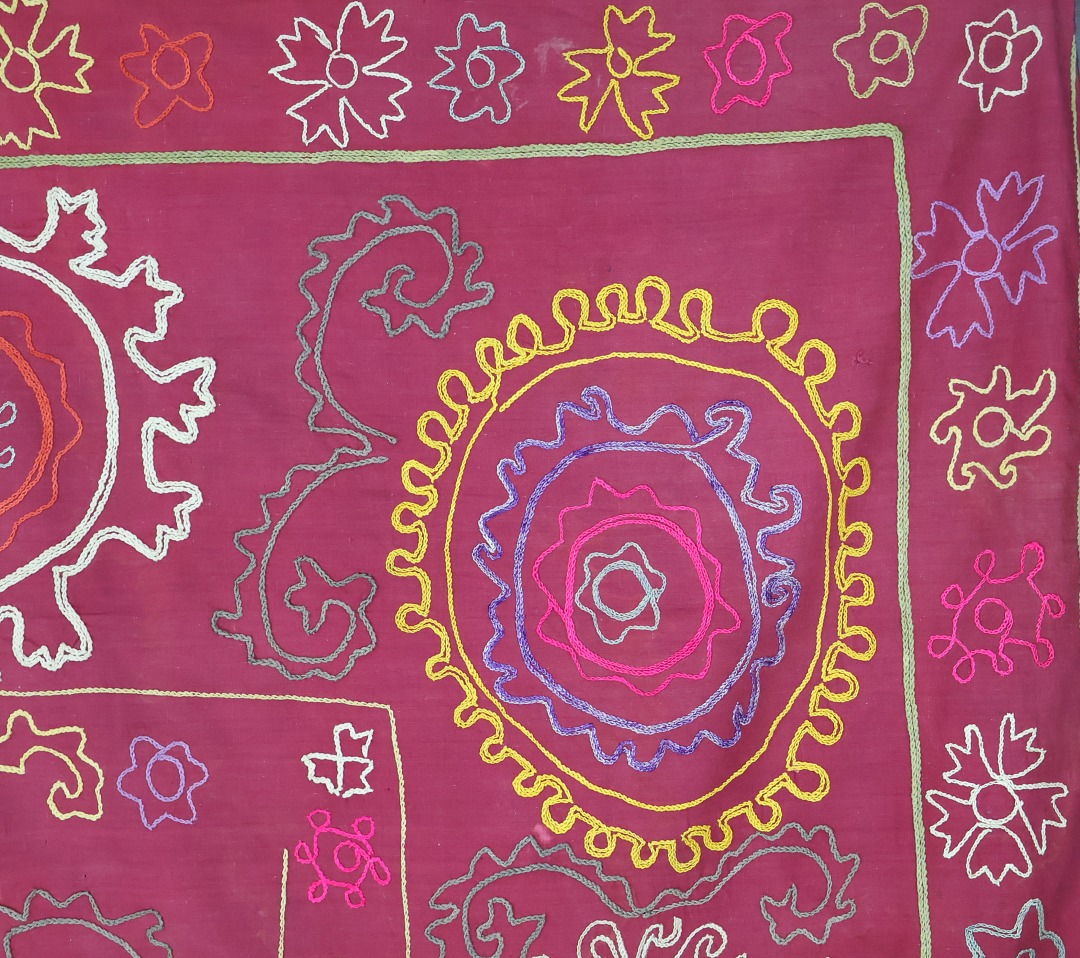
Suzani is the most internationally recognised Central Asian embroidery.
- Meaning: The word suzani comes from Persian/Tajik for “needle.”
- Symbolism: Motifs were chosen to protect brides, attract prosperity, and bless the household.
- Social practice: Dowry suzanis were stitched collectively by women—grandmothers, mothers, daughters—embedding emotional and spiritual intention into the textile.
- Motifs: Sun discs, pomegranates, vines, tulips, and protective amulets.
- Technique: Predominantly chain stitch on cotton or silk, often in large panels later joined together.
2. Kazakh, Kyrgyz, and Turkmen embroidery
These traditions reflect nomadic aesthetics and practical use.
- Kazakh & Kyrgyz: Strong geometric forms, bold colours, and motifs referencing mountains, rams’ horns, and cosmic order.
- Turkmen: Dense, highly structured patterns with deep reds and metallic accents, often used on ceremonial garments and animal trappings.
- Techniques: Chain stitch, couching, and bead or metal-thread embellishment.
3. Regional diversity and shared heritage
Embroidery across Central Asia is shaped by overlapping ethnic groups, fluid borders, and centuries of trade. The result is a vast spectrum of local styles, each with its own motifs, stitches, and garment forms. The Encyclopedia of Embroidery from Central Asia documents this diversity across 42 chapters, illustrating garments, tools, stitch families, and ethnic maps.